Birthday SALE! 20% Off Top Brands! SHOP NOW *
*Some exclusions apply.

0
*Some exclusions apply.
A touch of the master...Ivan Hancock
by Tom Gaylord
Exclusively for PyramydAir.com. Copyright © 2007. All Rights Reserved.

They call it the "baby Patriot," in reference to Webley's monster 30-foot-pound springer. But, where the Patriot is big, heavy and takes lots of muscle to cock, the Tomahawk is svelte and easy on the arm. Plus, it’s a delight to look at!
The Tomahawk comes from the bench of Webley custom designer Ivan Hancock. Ivan operated the Venom company for many years, turning out some of the most innovative and expensive spring air rifles in the world. The Venom Mach I was a highly custom breakbarrel that was the first spring rifle to regularly exceed the sound barrier with lightweight .177 pellets. Besides that, it ushered in the famous Mach I trigger, which later became the Mach II.
A few years later, Ivan went to work on an underlever design at the request of U.S. enthusiast Trooper Walsh. Originally called the Wonderlever by Trooper, Ivan eventually created the famous Venom Mach II. That rifle led to the development of the TX200 and especially to the Pro Sport underlever rifles from Air Arms.
What does any of this have to do with the Tomahawk? Well, the Tomahawk has Ivan Hancock's hand all over it. Here is a spring rifle retailing under $400 with the features, styling and much of the quality of hand-built air rifles costing $2,000 and up. What it lacks is the superior grades of wood and the extensive hand checkering. Even there, Webley has found a way to put in a high percentage of the quality.
One specific example is the trigger, which is an example of what can be done when a Rekord trigger design is made by hand and modified to be extremely user-friendly.
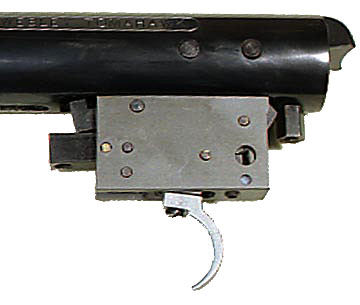
What Webley has done with the Tomahawk trigger is turn it into a design that can be manufactured, yet still retain much of the fine sensitivity and crispness of the Mach II. A new Mach II trigger sold for over $300 when they were still available, yet this entire RIFLE costs only $100 more! In my book, that’s worth mentioning!
The shooter can adjust the length of the first-stage pull and the length and weight of the second-stage pull. There is no trigger stop as of this writing, but here’s hoping the folks at Webley will find a way to incorporate one in the future.
The pull is as light as many would like. Two pounds seems to be the safe lower limit. But for hunters - and this is a hunting rifle, first and foremost - a 2-lb. pull is very light. During inclement weather, when freezing fingers loose their sensitivity, two crisp pounds are as little as you want. It may seem a bit heavy when shooting off the bench, but the Tomahawk was made to carried afield in search of game.
More Venom styling
Look closely at the shape and contour of the stock, and you can see Ivan’s influence. The forearm is fluted on both sides and there’s a subtle flat spot forward of the triggerguard for the off hand or to be used as a knee rest. The pistol grip is relatively vertical, which gives the shooting hand the best possible anchor. Note the characteristic slight flare at the bottom front of the grip. It doesn’t look like an electric guitar like some modern custom rifles - just a classic rifle stock.
The pistol grip is full and symetrical, for ambidextrous operation. An ever-so-slight palm swell fits the palm of either hand - yes, this is an ambidextrous stock with a cheekpiece on both sides.
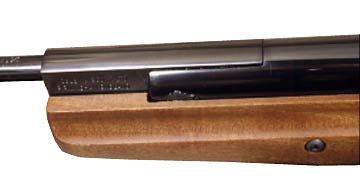
The top of the breech is level with the spring cylinder, a classic Hancock detail. Also, note the flutes in the forearm.
The Tomahawk not only looks good to the eye, it also feels good when you bring it to your shoulder. There's something very right about how the gun sits in your hands, and you'll just have to experience it for yourself. Every air rifle Ivan designs has the same feel, though the individual styling points may differ quite a lot.
Cocking is easy
The first thing you notice when preparing to shoot is the extreme ease of the cocking effort. It feels more like a 15 foot-pound gun than the 20 it actually is. Webley put in their trademark bank-vault detent breech lock, so you may have to slap the muzzle to open it. But, the cocking stroke is pure Venom! It cocks with an unbelievably light 33 lbs. of effort that remains constant throughout the barrel stroke. It would seem that Ivan knows a thing or two about spring powerplants. It’s definitely a rifle to keep away from the kitchen-table tinkerers.
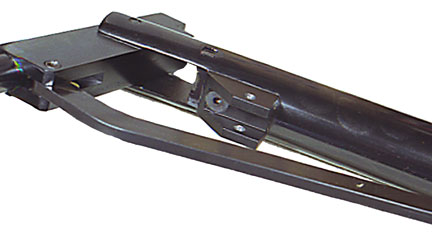
Important information
Check the tightness of what Webley calls the stock screw carriage screw. Keeping this screw secure is important to the smooth firing behavior and accuracy of your Tomahawk. Don’t over tighten the screw and strip the head or ruin your wrench - just be sure it's snug and remains so.
Let's shoot!
The Tomahawk is primarily a hunter’s rifle, so shooting off a bench isn’t the best way to sample it. I found it requires technique to group tight from the bench. The artillery hold is definitely needed for best results, and you do that like this: just rest the forearm on the open palm of your off hand - forget sandbags unless your palm is between them and the stock. Do not hold it tight anywhere; just allow it to float in your hands, and it will reward you with very good groups. The crisp trigger is a plus here.
Hunters will find the Tomahawk a very personal experience. They'll have to learn their rifle for best results, but this should prove to be one of those guns that gets better with practice. Start with a light hold and place the palm of the off hand forward, where you can feel the cocking slot. That’s what seems to give the tightest groups.
I tested the gun with Webley's Lazapell and Lazadome pellets. The Lazapells look a lot like Crosman Premiers, but they're made from what looks like pure lead and not the alloy Crosman uses. Though they were the lightest of the two at 14.4 grains, they fit the breech very tightly. The longer 15.8-grain Lazadomes fit much better and proved to be the best pellet in this test. Crosman Premiers were close behind, but they may need to be lubricated at this power level to keep from leading.
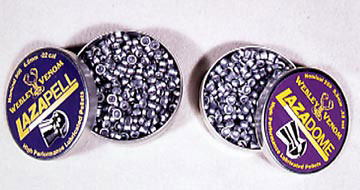
I used Webley Lazapells and Lazadomes to test our Tomahawk. The heavier Lazadomes fit the breech better and grouped best.
Webley Tomahawk, .22 caliber rifle Muzzle 1' from start screen, 10 shots, 73 degrees F |
|||||
Crosman Premier, 14.3 grains |
Webley Lazapell , 14.4 grains |
Webley Lazadome, 15.8 grains |
|||
| High | 808 fps | High | 816 fps | High | 733 fps |
| Low | 765 fps | Low | 800 fps |
Low | 722 fps |
| Average | 786 fps | Average | 810 fps | Average | 727 fps |
| Extreme spread | 43 fps | Extreme spread | 16 fps | Extreme spread | 11 fps |
| Standard deviation | 16 fps | Standard deviation | 4 fps | Standard deviation | 3 fps |
| Muzzle energy | 19.62 ft-lbs | Muzzle energy | 20.98 ft-lbs | Muzzle energy | 18.55 ft-lbs |
So there it is - 21 foot-pounds in a lightweight, easy-to-cock spring rifle with beautiful firing characteristics! What’s not to love?
Final thoughts
This is essentially a Venom air rifle at one-fourth the price or less. Think about that. There was a time when you couldn’t buy a Venom unless you spent around $2,000, give or take, and half of that had to be paid up front - before the guns were produced. Now you can buy a large part of that same technology for just a fraction of the price. While it would be incorrect to say the Tomahawk is truly hand-built rifle like the Venoms were, it contains so much of the same attributes as to allow shooters on a budget to own a piece of history.
Buy With Confidence
Get FREE shipping on qualifying orders! Any order $150+ with a shipping address in the contiguous US will receive the option for free ground shipping on items sold & shipped by Pyramyd AIR during checkout. Certain restrictions apply.
Free shipping may not be combined with a coupon unless stated otherwise.
View Shipping Info
We work hard to get all orders placed by 12 pm EST out the door within 24 hours on weekdays
because we know how excited you are to receive your order.
Weekends and holiday shipping times will vary.
During busy holidays, we step our efforts to ship all orders as fast as possible,
but you may experience an additional 1-2 day delay before your order ships.
This may also happen if you change your order during processing.
View Shipping Times
It's important to know that due to state and local laws, there are certain restrictions for various products.
It's up to you to research and comply with the laws in your state, county, and city.
If you live in a state or city where air guns are treated as firearms you may be able to take advantage of our FFL special program.
U.S. federal law requires that all airsoft guns are sold with a 1/4-inch blaze orange muzzle
or an orange flash hider to avoid the guns being mistaken for firearms.
View Shipping Restrictions
Get the most out of your equipment when you work with the expert technicians at Pyramyd AIR. With over 25 years of combined experience, we offer a range of comprehensive in-house services tailored to kickstart your next adventure.
If you're picking up a new air gun, our team can test and tune the equipment before it leaves the warehouse. We can even set up an optic or other equipment so you can get out shooting without the hassle. For bowhunters, our certified master bow technicians provide services such as assembly, optics zeroing, and full equipment setup, which can maximize the potential of your purchase.
By leveraging our expertise and precision, we ensure that your equipment is finely tuned to meet your specific needs and get you ready for your outdoor pursuits. So look out for our services when shopping for something new, and let our experts help you get the most from your outdoor adventures.
View Service Info
Shop and purchase with confidence knowing that all of our air guns (except airsoft) are protected
by a minimum 1-year manufacturer's warranty from the date of purchase unless otherwise noted on the product page.
A warranty is provided by each manufacturer to ensure that your product is free of defect in both materials and workmanship.
View Warranty Details
Didn't get what you wanted or have a problem? We understand that sometimes things aren't right and our team is serious about resolving these issues quickly. We can often help you fix small to medium issues over the phone or email.
If you need to return an item please read our return policy.
Learn About Returns
Get FREE shipping on qualifying orders! Any order $150+ with a shipping address in the contiguous US will receive the option for free ground shipping on items sold & shipped by Pyramyd AIR during checkout. Certain restrictions apply.
Free shipping may not be combined with a coupon unless stated otherwise.
View Shipping Info
Want More?
Join Our Email List for News and Deals!
Join the Pyramyd AIR mailing list: Our e-mails are filled with new products, deals, sneak peeks, tips and tricks, contests and more - sign up today!
Text JOIN to 91256 and get $10 OFF Your Next $50+ Order!
* By providing your number above, you agree to receive recurring autodialed marketing text msgs (e.g. cart reminders) to the mobile number used at opt-in from Pyramyd AIR on 91256. Reply with birthday MM/DD/YYYY to verify legal age of 18+ in order to receive texts. Consent is not a condition of purchase. Msg frequency may vary. Msg & data rates may apply. Reply HELP for help and STOP to cancel. See Terms and Conditions & Privacy Policy.
Customer Support
Customer Support


Copyright © 1999-2024 Pyramyd AIR. All Rights Reserved.