
by B.B. Pelletier
Back in 1978, the airgun world was at the beginning of a velocity revolution. The FWB 124 had come to market earlier in the decade and was capable of almost 800 f.p.s. right out of the box. With careful tuning, it became the first spring-piston air rifle to break the 800 f.p.s. “barrier.” Hot on its heels, the BSF 55 was soon tweaked to 860 f.p.s., and even the old lumbering HW 35 was capable of just 800 with careful tuning of certain rifles. That left Diana, a major player, as the only quality German house without a player in the big game.
Diana (this was before RWS became a major distributor of the line) had their model 35, a large breakbarrel they advertised as shooting 725 f.p.s. In truth, the rifle barely made 675, which was only 25 f.p.s.. faster than the much lighter and slimmer Diana 27. Tuning did nothing for the 35. It was permanently hamstrung by a too-short piston stroke. When FWB, BSF and HW went off to the races in the early 1970s, Diana was left standing at the gate. The model 45 was supposed to fix that.
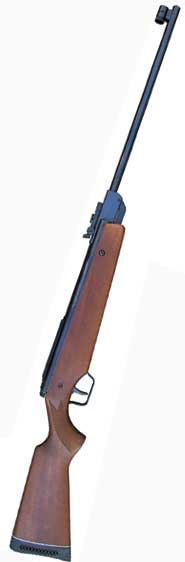
Diana 45 was a large, handsome breakbarrel spring-piston air rifle. This one is from 1983 and has all the earliest features.
The 45 first came to market in 1978. Those were still the days when Dianas were being made by Milbro in Scotland, so instead of calling them Dianas, all the German-made guns had to be called Original when shipped outside of Germany. The first Diana 45 to come to America came as the Original 45 and sold by Air Rifle Headquarters. The basic rifle got 790 f.p.s. in .177 and could be tuned to deliver 845-860. It was an immediate rival of the BSF 55, though it cost about twice what the smaller rifle did.
The 45 was a departure from Diana styling in a number of important ways. First, and in my mind, most importantly, they unitized the trigger. Prior to this, Diana triggers were a swarm of loose parts that worked only because they were held in close confines by the spring tube. Outside the gun, they were separate parts. The 45 trigger was the first modular trigger their sporting air rifles had.
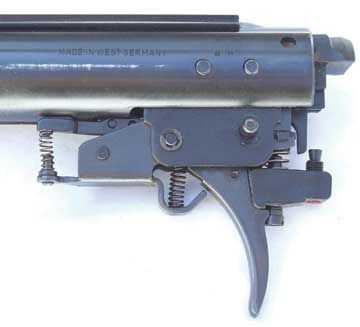
This trigger was Diana’s first unitized trigger system. It was very adjustable for its day.
Another design element was the introduction of a long-stroke piston. That’s where the 45’s power came from. The rifle was also very large and had a more Western-style stock. By today’s standards, it looks normal, but compared to the other air rifles available in 1978, it looked like a Weatherby among a bunch of military Enfields.
Diana retained their famous ball-bearing barrel-locking detent. That feature was so popular that Feinwerkbau had copied it on their 124. It made the gun open much easier than a similar rifle with a traditional chisel detent.
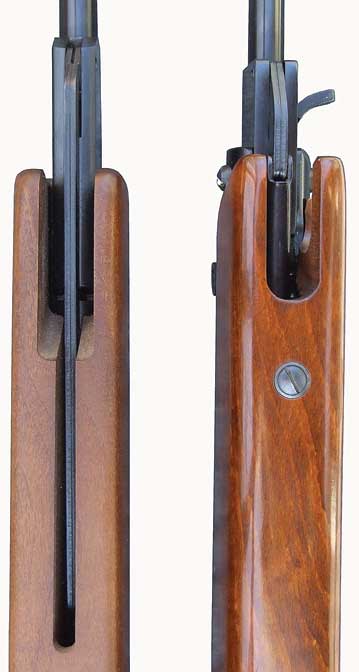
A comparison of styles. The Diana 45 cocking slot (left) had to be long to clear the one-piece cocking link when the barrel was broken for cocking. The HW 35 slot was much shorter because the rifle used a two-piece hinged cocking link that hugged the bottom of the action. The short slot was supposed to dampen vibration and be easier to install a sling swivel.
They stumbled with the piston and breech seals. By making them leather instead of synthetic, they gave away 150 f.p.s. Within five years, Diana (now called Diana everywhere and distributed by RWS) would bring out the models 34, 36 and 38. Each more powerful than the 45 and all, except for the walnut-stocked 38, far less expensive. It’s difficult to sell an 850 f.p.s. rifle for $300 when you’re also selling a 1,000 f.p.s. model for $100, which was the case with the Diana 45 and 34 in the mid-1980s. They added features like front sight inserts and walnut stocks. Until the 45 got its own synthetic breech and piston seals in 1988, it was an uphill battle.
That said, the big 45 still has a large following of enthusiastic owners. Of the Diana breakbarrels, only the 34 is loved by more shooters, and it was produced in far greater numbers. There were many different models of the 45, including a factory commemorative model with a walnut stock and an inset brass medallion.
The 45 remained in the Diana line until 2004. It’s still shown on the German website, but it’s no longer in the catalog. Models like the 350 Magnum have eclipsed the power of the final version by so much that it simply could not keep up.


B.B.
I like history like this in part because it gives me a look at gunsmithing principles and their evolution. The messy trigger design remind me of one of the few valuable things I know which I picked up from my man, Clint Fowler. He says on his page that a principle of an accurate rifle is that when firing the parts do not have independent angular accelerations but all work together as a whole. One can think of the shooter as an additional part of all this too with the body position, trigger squeeze, breath control and everything else in harmony with the gun. It’s quite profound to be aware of this–and fun too.
Matt61
B. B. –
Aaarrgghhh! Every time I think I’m zeroing in on a good choice for my first “real” air rifle, you go off and post yet another great write-up on a rifle I’d love to spend time with.
I’m sure my dilemma is familiar: I grew up with various Daisy and Crosman models. I had great fun and learned a lot – but I remember seeing ads in the back of magazines about these new “adult air rifles” from Europe, and the amazing things they could do. But realities of teenage cash flow meant I could only dream.
Fast forward through the years: I’ve still got my first Daisy model 95, but even I’ll admit it’s just not accurate enough to be much fun. My Ruger Mark II rimfire is accurate – but the realities of small kids and schedules means I can’t get out to the range very often.
So I find myself sneaking down into the basement most every evening I can. I can *just* squeeze in a 10m range, and my wife has learned that the funny “fftthhT” sound just means I’m relaxing. My Crosman 1377 and Daisy 860 (a pump-up rescued from a neighbor’s basement) are fun – but I’m looking for something more.
That something will be a rifle. Something capable of rewarding patience and practice in my basement range. A rifle whose purchase I won’t regret in years to come. I’m not looking for hunting power or range; I know that 1000 fps is mostly marketing. High velocity doesn’t make much sense for what I have in mind anyway; I’ll likely rarely get to use it outdoors. I’m trying to stay away from the cost and complexities of CO2 and PCP models, so I’m left looking at springers and various pneumatic models.
Most modern springers seem to be overkill for what I’ve got in mind – and learning to control that big spring’s recoil seems at odds with a goal of tack-driving accuracy. Then I see things like the Diana 34 and 45, which represent what I remember when such quality airguns first showed up on the US market when I was a kid. I also keep coming back to the IZH Baikal 61, which gets surpringly good reviews for its price. And I even find I like things like the Daisy Avanti single-stroke models.
So I’ve been through the Pyramyd AIR “airgun selector” menus; I’ve read tons of descriptions, and I’ve been digging through your blog posts – yet I still find myself going in circles, looking for my perfect air rifle.
Any advice on how to proceed would be appreciated!
Phil
Phil,
Absolutely! Look long and hard at bopth the Beeman HW 30 and the Beeman R7. The R7 has the better trigger and stock, but the powerplant is identical.
Either one will fulfill your dream.
If the HW 50 were still available, I would also list it.
B.B.
I have a 45 and I’m not sure if it has the leather seal or the synthetic .Its a early 80 gun . If my gun has the leather seal can I change it to the synthetic one. I called Umarex and they told me I had to send the gun to them to have a new spring and seal installed . I told them many times I wanted to do it my self but they keep saying no they would not send me the parts . Do you know of a place where I can get a new seal and piston for the 45 so I can replace them my self .
45 user,
Contact Pyramyd AIR. They should have the parts you need.
888-262-4867
B.B.
That was the first place I called . the told me to contact Umarex.. . Umarex has the parts they just won’t sell them to me . They said it was to dangerous for me to try to repair and that I had to send the gun to them . I got so mad at the guy in the parts department or repair department I had to hang up before I started saying thing that wasn’t going to be pretty. Do me a favor call Umarex and tell them you want a new spring and the newer synthetic piston and housing what ever is needed to change it from the leather seal and see what they say to you and get back to me if you don’t mind .
45 user,
Okay. I will look into this. Some policies may have changed.
B.B.
Well B.B pelletier I have been on a few forums and I found out a few things about my 45 . I have a 1987 so it has the leather seal . RWS or Diana put a rivet on the top of the piston instead of a screw . So you have to drill out the rivet just to get the old leather seal off . Then you have to makes threads in the hole you drilled out so the new 0-ring seal that this company makes here is a link to it . http://vortekproducts.com/ourstore/Seals-Tuning-Parts/Diana-Piston-Seal It doesn’t say its for a 45 but the tube is a 28mm tube and that’s what this seal fits . here is a link and some pictures of someone that did a leather to o-ring change to the same piston . http://www.gatewaytoairguns.org/GTA/index.php?topic=60435 . If you scroll down you can see the red top and o-ring under it . I also found out the o-ring is better than the synthetic ones . but the cylinder has to be in perfect shape for the o-ring to work . If you notice in the vortek seal link they have 2 kinds of seals, the synthetic will work better if your tube is perfect. The guy that did the conversion also changed the spring here is a link to that spring https://www.airrifleheadquarters.com/catalog/item/251488/10099208.htm If you read his story he went from a leather seal that looked good but wasn’t because he went from 510 fps to 840 fps with the o-ring thats over 300 fps with a 10 fps deviation with only a few shoots in . I contacted him through the forum and he said if I ran into trouble he would walk me through it . So I think I’m going to do it . He has different parts to the conversion I think 3 pages with pictures of the take down of the gun . I think I’m going to do a video and put it on youtube when I do mine because I can’t find a video of the conversion anywhere . I found a great video on youtube of a guy using a quick grip to relieve pressure of the pin that holds the spring in place . here is a link to that .Once you get the spring out ,thats the scary part for me because I have never taken a air gun apart before that has a spring in it and all the horror stories you hear , but the guy in the video makes it look easy . https://www.youtube.com/watch?v=4JQXmqa2Uj0
45 user,
Okay, you found out on your own.
Just be sure to use a mainspring compressor, because the Diana 45 mainspring is under a lot of tension at rest.
B.B.
B. B. –
Thanks for your many insights on this blog. Now off for some HW 30 and R7 reading!
Phil
Did I miss the 50 dollar in 5 min. experiment?
How about guns/air guns you’ve passed on?
btw I was reading about shooting 30 cals a few blogs ago. I started with a 30-06 Browning bolt action when I was a kid. I still have all my teeth. After that, shooting everything else went pretty well.
I’ve also lost your history of .177 velocity milemarkers. I guess I’ll search some more.
Phil,
I sure can identify with your situation since it was mine less than a year ago. It’s hard to believe since that time how deep I’ve gotten into the lore of guns. I would never contradict a suggestion by B.B. and the fact is the HW30 is one of my dream guns.
But since you mention the IZH 61, I thought I would add some thoughts on it. The barrel is great; inside 10 meters I doubt you could tell the difference from much more expensive guns. The ergonomics are excellent, especially if you set the screw inside the stock on maximum; you get a good four inches of extension which are not shown in the display photos. The trigger is fabulous. And here is something that is more objective. If you like to shoot, especially within a tight schedule, it helps to have a repeater which can crank off the shots quickly. The time taken to break a barrel and load a round will add up over time. (As far as sheer output, the Crosman 1077 will send out even more rounds and approaches target rifle accuracy from what I can see although its trigger will always hold you back a little.) Finally, the IZH 61 is going in up in price; it recently broke the $100 mark.
Anyway, just wanted to share my thoughts on a similar situation. You can hardly go wrong with the many good choices out there.
Matt61
Phil,
One other thing, I wouldn’t limit yourself to just a rifle. The Daisy 747 is a wonderful pistol for all the reasons that you’ve seen on the blog, and I’ve found that the match pistol shooting offers a distinctively different gratification from rifle shooting.
Matt61
henry
Thanks for yesterday’s review of the Ed Brown rifle. I didn’t know that any kind of .22 could a target at 1500 yards. That’s quite a set-up to shoot those distances out of your backyard.
Matt61
Hello, B.B.,
I enjour your column and your expertise. I’m very tempted to buy the Daisy 747, for its accuracy and because I live in an apartment.
Are there any airpistols that are similarly quiet. I’m curious about other weapons, with a similar powerplant as the 747, as well as quiet multistroke guns, quiet CO2 powered guns and (if there are any) quiet sprngers and quiet PCP handgus. If you could rate the guns from quietest through the noisiest, Id appeciate it.
I enjoy reading your blog daily, and I value your opinion.
Best regards,
Andre
Matt61
If you call a lake a target, it sure can.
Andre,
Springer will generally be the quietest. The Daisy 747 is special. Most single stokes make more noise.
An HW 70 is pretty quiet, but the 747 takes top honors.
In CO2, only the vintage APP 661 is quiet, and that’s because it’s underpowered.
B.B.
Matt61 –
Thanks for your comments on the IZH 61. I’ll admit I first dismissed it, purely because it first looked too much like a toy. But I couldn’t ignore it after finding so many positive reports.
Yes, a pistol is also on my list (the Gamo Compact vs. IZH 46 series has been remarkably well timed for me), but I plan to get a rifle first.
Phil
Like many others I am sure, the RWS 45 was my introduction to adult airguns. I bought mine at Atlantic guns back in 89. It has always been the gun I compare all the others I have bought too. It is a bit massive and that extra long barrel seems to really go on forever but it does make the cocking easier than others of similar power. I looked back at some of my records to see that it was pushing Silver Bears at 960 fps and Kodiaks at 774 but I had marked Silver Jets as the most accurate. It was always a well behaved gun with no twang. I still own that gun but sadly dont seem to shoot it very much since my collection of HW’s has grown and as I have grown to appreciate lower power.
Sam
Man I have been away too long! Nice report BB. The 34 is the work horse of the Diana line. It is a shame some of the older models have been replaced by the “latest&greatest” fps “kings”. I must say my favorite fun gun now is my 1993 Diana 24.What a sweet little shooter! Yes I have been away too long from the site that got me started when I got my first computer. I am still addicted to airguns in a big way! I see alot of familar names here,,I feel the need to come back “Home”. Tim.
just a quick note from a fellow airgunner up here in canada for the guy wondering what adult air rifle to get. i agree with b.b. look very hard at a hw 30 and also if you are near to a canadian border you could come across the line and buy the hw50 b.b. spoke about and also a note for b.b. we do have the last of the slavia 630,631. because we can only get a rifle up to 500fps without an fac i do not have the issues with too much power for the basement or the hold sensitivity that some have but with decent power to do some small game hunting.
Sam,
I think I remember that specific 45! It was one of the first new models with synthetic seals.
I’m still shooting and loving my Garand! Now I need a carbine to go with it.
B.B.
Dragonslayer,
Welcome Back!
Dragonslayer,
By the way, can your 24 take a moose?
A quick question:
A CONDOR MOD 45 (.177 cal) looks like the Diana mod 45 in your article. Also marked made in West Germany – so i am assuming it’s early to mid 80’s. A buddy just got this as a gift, but it is missing the cocking lever – any ideas if the part is available and where. Any help appreciated -cheers
Condor 45,
It’s probably a Diana under another name.
This guy may be able to help:
B.B.
WOW!!! I just recently have RE-stumbled upon airgunning again.I've been in the pest control field for 30+ years.Started out with a cheap Crosman I want to say a 760 pumpmaster??? shot many a rat in the back alleys of Wash DC before things really changed.But my greatest joy was when I bought my first airspring gun a RWS 45.I still remember the first night I took it out and took my first shots at some rats that were hanging out behind this resturant that had metal steps leading to the back door.After each shot I would hear a richocet and the rat would seemingly wander off unharmed.Well after the 4th shot I was extremely dissatisfied with myself and the gun,but only after closer inspection did I find 3 quite dead rats with entry and exit wounds.The silver jets (I think)had gone clean through them!!! I haven't used it in years but after stumbling upon so many websites,forums,and blogs were many are enjoying airguns maybe I'll get her back out again. Great site guys thanks!!
Steve,
I can relate to your story! I didn't "rediscover" airguns until long after a firearm life.
Once I realized that airguns allow me to shoot almost anywhere, at anytime at a nominal expense I was hooked.
If you haven't already discovered the secret to being accurate in shooting an airgun, like the RWS 45, is the artillery hold and determining the most accurate pellet (after trying many pellets) you need to be part of our current discussion. I sould encourage you to use the search box on the right side of this site and type in "artillery hold" to learn the secret (there's even a video that B.B. did recently that explains the hold in order to make your gun as accurate as it is capable of being).
You've posted your great comments under an old article that B.B. wrote (back on April 15th of 2008. Over a year ago!).
Most airgunners, like yourself, are sharing stories, asking and answering each others questions in the comments section under the most recent article that B.B. has written (B.B. writes a new article everyday, Monday-Friday). Here's a link, that you will need to copy and paste, that will always take you to the most recent article that B.B. has written:
/blog//
Look forward to seeing you there!
kevin
Steve,
Welcome, I "rediscovered" air guns like Kevin. I really enjoy shooting in my yard w/o a hassel. Shooting rats in DC and getting paid for doing it, what a deal.
Had a friend who worked in the clubs across from the Navy Yard and they used to shoot them inside after closing–employees only 🙁
Are you still in this area?
Mr B.
I came across a APP 661 CO2 pistol. It is lacking the magazine. No box or instructions. I wonder what it would sell for?
Anonymous with the CZ Slavia APP661,
Your gun was made 1960-1970 to shoot 4.5mm round lead ball. Blue Book says in 80% condition it's worth $60.00. Knock off $20.00 ??? for the missing magazine?
kevin
Warning, danger, Will Robinson!
You may never find a magazine unless you have good friends in Europe.
B.B.
How did you remove the action from the stock ? Front screws are easy. But, above the trigger are I not sure what to do – I don't want to cause any damage.
I do not understand what you are saying by "…above the trigger are I not sure what to do…".
There are three screws that hold the action in the stock. The two on the forearm and the front triggerguard screw. That's all.
But why are you taking the gun out of the stock? Unless there is a reason, I would leave it in the stock.
B.B.
I managed to remove the action from the stock.
It was the pin in the stock (over the trigger) that was giving me trouble, I just tapped it out.
The rifle has got very rusty and I need to remove the stock to clean the rust off.
NAJ
NAJ,
That is an old 45. From the 1970s or '80s probably. Diana did away with that pin in the '90s. And today the 45 uses the same action as the 34.
B.B.
NAJ, are you planning to completely tear down the '45? If you do, I may be able to offer a useful tip or two. Contact me a vfblovesnancy@yahoo.com if I may be of some help.
Man,I am a sad case.Here you guys have posted replies to me and I never came back to check until now!!! And here I thought no one cared!!!
Anonymous 45 or NAJ,
you'll get many more responses to your comments if you post on the current blog, even off-topic comments are welcome!
The current blog can be found at
/blog//
This will bring you to the most current blog – scroll down to the end of THAT FIRST BLOG and do your post. Be careful as there are numerous, older blogs on this screen.
We all look forward to having you as a regular visitor and contributor to the comments section. By all means, however, read the older blogs. There is a wealth of information there!
Fred PRoNJ
I've owned a model 45 since 1995, seems weak, may have been stored cocked is there a service to replace spring or even upgrade to theoben? thanks steve
I have a Diana45 "MADE IN GERMANY" Production Date: 05 99
This one is Very Powerful!!! i Don't know why?
Steve-J,
there are a number of services and tuners around that can install a new spring in your 45 and tune it to make it shoot smoother (not more powerful as that involves more than just a spring). You can access Umarex who is the current importer of Diana air guns- go to:
http://www.umarexusa.com/pages/CustomerService.aspx
Pyramyd air will also work on these – /
and there are other private tuners I will be glad to recommend if you desire. If you want to do the work yourself and feel competent, BB did a blog about tuning an air rifle and you can find it at:
/blog/2006/7/spring-gun-tuning-part-4-lets-disassemble-a-gun/
this is Part IV and I've provided this since the first 3 parts are listed here.
By the way, you've posted your comment on a blog that's over 2 years old. Only a core of volunteers, of which I am one, monitor these. For greater exposure for your questions or comments, go to
/blog/
Off-topic comments and questions are always welcomed. The Blogs appear Monday to Friday. By all means, however, read the older blogs. There's tons of information to be learned from them.
I have an old Model 45 that was built 11 80. Is it worth rebuilding? It is near mint shape.
Why does it need rebuilding? What does the chronograph say?
B.B.
Anonymous, BB's right. It's a pretty reliable gun. The leather seal in that thing is probably still good.
My own 45 is a cosmetic basket case… when I got it the bluing was completely stripped off the now-rusty barrel and half the spring tube, and the stock had been stripped as well. Which is why I got it cheap. Now, I own about 70 spring rifles in both .22 and .177 – some of my fixed-barrel guns (RWS 52, Stutzen, 300R) are a bit more accurate than the 45, but none of my breakbarrels can beat it at longer ranges (60 yards).
I have purchased Diana in the year 2008 from Dubai from Al syed MODEL 45 T05 in .22 calib with synthetic or plastic washer does any body know what is the power of this machine in terms of JOULES.
great article!
I have a RWS 45 that I havent fired in about 15 years. stored uncocked.
is there anything i should do before using it again?
thanks!
You could just start shooting the rifle with no harm, but to go that extra mile, drop three drops of silicone chamber oil down the air transfer port and stand the rifle on its butt for 30 minutes. The cock the gun and rotate the action around 360 degrees to spread the oil around the piston seal.
Then shoot a premium pellet, like a Crosman Premier or a JSB dome.
B.B.
How long can I have the Diana 45 cocked before the spring is damaged?
Cocking is cumulative. So every time the gun is cocked, the clock picks up at the point it stopped the last time it was cocked.
During a month-long test I discovered that mainsprings begin to fails after being cocked for several weeks. After a solid month they will still have 94-96 percent of their original strength.
B.B.
Hello I borrowed an AWS Diana 45 air gun from a friend. The trigger spring part number 65-302506 broke. I would like to return it in working order. Does anyone know where I might find a replacement spring?
Thank you
Stan-
Stan,
Contact the technical department at Pyramyd AIR. They have many vintage RWS Diana parts.
The model 45 is no longer imported into the U.S., so it is considered a vintage gun.
888-262-4867 and ask for the tech department.
B.B.
The Diana model 45 was my first adult air gun. i still have it, in fact i was just shooting it a few minutes ago.
When I first got it, it was a rough shooting gun, but I had it tuned by Air Ventures in Bellflower, california and it smoothed right out.
Now it's really a sweet shooter and very accurate using Crosman Premier pellets. It is .177.