
by B.B. Pelletier
A reader requested this post, but in truth I really wanted to do it anyway. Pyramyd AIR calls this kind of pellet trap the AGE Quiet Pellet Trap, but everywhere else it’s called a silent pellet trap.
Robert Beeman deserves credit for developing the silent trap back in the 1970s. He made it attractive, so shooters would be proud to hang it on their walls. And it was never cheap. Even back in the 1970s I believe they cost $39.00, which was a lot of money. Today they cost even more. So, what are they and are they worth the price?
How it works
The heart of the silent pellet trap and the thing that makes it work is a material called duct seal. Used in the heating and ventilation trade to seal air passageways, duct seal is a dense, semi-sticky material that may look and feel like modeling clay on first inspection. But modeling clay isn’t as dense as duct seal and cannot do the job of stopping pellets as well. What stops the pellet is the duct seal’s density and resistance to deformation.
The problem is, duct seal isn’t cheap! You buy it by the pound and it takes several pounds to fill a trap. My trap, for instance, is 6 by 9 inches and has 9 pounds of duct seal in it. That makes a depth of about two inches when the material was new, but now it has so many thousands of pellets buried in it that the depth is more like three inches.
Added insurance
When I built my trap I decided to back the duct seal with a steel plate. That way, if a pellet made it through all the material and still had some energy, a thin plate of steel would stop it from penetrating the back of the trap and doing damage. For the steel plate, I cut up a cookie sheet, which got me into eternal trouble with my wife, who apparently was not finished using that sheet. In theory my idea was good, but in practice it had a major flaw.
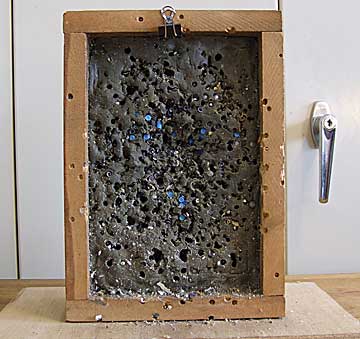
My trap is homemade and ugly, but it has been in constant use since new and it’s still working fine.
Do silent traps even NEED this steel plate? The answer depends on how you use them. I originally made my trap to stop pellets from guns producing 20 foot-pounds at the muzzle. The steel plate was included to give insurance against the few (I thought) shots that would be above that limit. In practice, however, I find myself using the target with guns that produce as much as 35 foot-pounds and it’s still okay. The reason why might surprise you.
A “seasoned” trap
In the beginning I tried to keep my trap clean and faithfully dug out each and every pellet that impacted the duct seal. Then I became lazy – or rather I was shooting so much that it proved impossible to keep up with the cleaning. Robert Beeman had written that if you let the pellets accumulate they would fuse into a large mass of lead that would be easier to pry out of the duct seal when the time came. What I found, though, was that they don’t really do that. They remain individual pellets, but they raise the overall level of duct seal in the trap! And what that means is that the old pellets become a layer of lead that help stop new pellets from penetrating. In other words, they make their own metal penetration shield.
A reader asked recently how many shots he could expect from a silent trap before it had to have its duct seal (the most expensive component) replaced. I told him my trap has about 50,000 on it and I still use it all the time. But I wondered whether he believed me, so I thought I’d show you all what a well-used silent trap looks like.
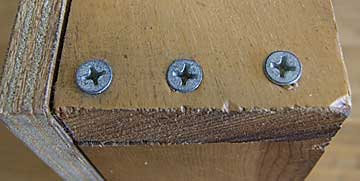
My trap is screwed together, rather than nailed. I felt it would better withstand the shock of repeated impacts. Note the slight gap between the backer board and the trap frame. There’s a steel cookie sheet screwed to the frame at that point!
I will finish this report on Monday.


B.B. said: “When I built my trap I decided to back the duct seal with a steel plate….In theory my idea was good, but in practice it had a major flaw.”
was your “flaw” the fact that you found you didn’t “need” the steel plate?
what is the minimal thickness you would use for your plywood backing?
thanks
BB,
This may sound like a dumb question, but I’ve never worked with duct seal or the silent trap.
I bought the pellet trap from Pyramyd air. I was a little confused what to do with the two bricks of duct seal (leave them as bricks, cut them to shape, etc). Unlike your trap, the one i bought has a 2×4 brace at the top. I wasn’t sure how to load the duct seal into the trap. I ended up with gaps in the duct seal and some pellets miss the duct seal. The 2×4 is not covered at all.
Can you tell me how to handle the duct seal. Would have been nice to see some instructions come with the trap.
Your one flaw was to use your wife’s “seasoned” cookie sheet instead of going to a thrift store and getting another seasoned cookie sheet for $2 and using it instead. Or probably just not have made it bigger?
KTK
hey BB,
Any interest in doing a post on the Beretta CX4 CO2 Tactical Air Rifle. Doesn’t look to be very accurate, but I don’t think that’s what they were going for. Might be fun to light up some soup cans at semi auto…
As usual, another excellent article, about a subject which is of the highest interest to airgunners…
Thank you BB!!!
Rod.
B.B. Do you think that the “silent trap” could be used for 22 cal rimfire bullets (pistol)? Their fps is less than some airguns, e.g., Gamo’s Hunter Extreme. Thanks, Don.
B.B.
Is plumbers putty dense enough to use instead of duct seal?
.22 multi-shot
Flaw,
The flaw was the fact that I used my wife’s cookie sheet for the backer.
I’d make the box 3/4″ thick. Half inch will do, also.
B.B.
Confused,
The duct seal should be evenly distributed across the back, because it’s what stops the pellets.
If it has to be thinner at one point, make it not less than one inch thick there.
B.B.
Frogman,
I will start the report this next week. I have the gun.
B.B.
Dpon,
I wouldn’t try a silent trap with .22 LR ammo, but perhaps .22 CB caps if the duct seal is 3″ thinck and backed with steel. The heavier bullets penetrate so much more.
B.B.
.22 multi-shot,
I answer that question on Monday.
B.B.
BB,
Is a bushnell 8-32x40mm model 4200 as good as the burris 8-32x50mm scope?
-sumo
bb, i’m guessing over time there would be a mixture of pellets and “paper” (from the holes made in the paper targets) in the duct seal. does the paper cause problems with the duct seal over time?
thanks
Sumo,
I have less experience with this Bushnell, but I have read a lot of good reports about it. I have never read anything bad about it, either.
B.B.
Paper,
You’re right, there are bits of paper and they do not hurt the trap one bit. I do nothing about them.
B.B.
B.B.
I was too cheap to buy the above trap so I made one, using 2 inch thick hardwood (which I had laying around). For the inside backer I use the thick phone books provided every year by the phone company. I get about 6 per year for my office so I have plenty but you can pick them up at the recycling site for nothing. Just change mine when it gets shot out. Works on both .177 and .22. Targets can be attached with push pins.
Bill D.
B.B.–left several comments over the past 2 day , howevfer they don’t appear to be making it thru-will skip the question, however have a new movie to add to your list-Shooter with Mark Walberg-thanks-Scott
unrelated, sorry…..
With the Gamo and RWS Stutzen rifles, where exactly is the lever to single pump the gun? I assume its likely to be underneath, so does that mean that if you look at the bottom of the gun it has a massive piece of stock missing? If so, i imagine it kinda spoils the overall look?
Bill,
That’s a pretty good idea!
B.B.
Scott,
I’ve lost messages, too. I discovered that I was hitting the red “close window” button instead of the Publish button. If you are on a PC, that would be an X square.
B.B.
BB and others,
I see someone on E-bay selling 5lbs of duct seal for $7.00,pretty reasonable.
Brian.
Stutzen,
The underlever is well-fitted under the stock. It doesn’t look bad at all. There is a small place where your finger can pop open a retaining latch and the underlever drops free for grasping. It’s been well thought-out.
B.B.
B.B.–if the rws 350 were your only option for a rifle and you wanted to target shoot at 40 to 50 yrds which would be your choice of caliber-I have to send mine back to the factory to be replaced-it’ chambered in .177 To punch holes accuratly and in good groups .177 or .22–thanks Scott
BB can correct me if I’m wrong, but I’d guess that a 350 in .177 would be sending all but the heaviest pellets at transsonic supersonic velocities. I don’t think most pellets fly well at those speeds.
When I bought an RWS48, that’s why I went with .22 cal… almost any pellet will fly well below 900fps. At 60 yards, mine is so consistent that it makes me sick (I will never shoot as well as the gun!)
BB.
I kmow this is off-topic, but i was wonering. Aproximately how many shots can I get from one full air cilinder in a 10 meter pistol as the Steyr LP10, Steyr LP2, Benelli Kite or similar.
Thanks
Wade
Scott,
I’d go with the .177 to shoot targets at 40-50 yards. The pellets are cheaper and no less accurate than .22.
B.B.
Vince and Scott,
I spoke too soon and Vince it correct. The 350 is too powerful for .177. Perhaps the .22 is the better choice.
Since you already have the .177, try Kodiak pellets and even Eun Jins. They will slow it down.
B.B.
Wade,
All these guns use air cylinders of varying sizes. I tested a Kite with a small cylinder and got 100 good shots, so I would estimate the large cylinder would get 120-140. The same holds for the other guns.
B.B.
BB,
As for the silent pellet trap – I’ll bite, what was the backstop BEHIND the trap? There’s enough holes in the frame to indicate that at least a FEW pellets went totally awry!
Or is that where the rest of the cookie sheet went…
vince,
i remember somthing about bb cracking the foundation of his house but i am not sure.
-sumo
Vince,
I have used this trap for many years, so it hasn’t always been indoors. Sometimes there was a backer board behind it (indoors) and other times I let the range takie care of any strays (outdoors).
If I am right about 50K shots being fired at it, those in the frame are the strays for that many shots.
B.B.
Sumo and Vince,
Yes, I did crack the cinderblock foundation of my house, but not by missing the silent trap. I did that when I missed the steel bullet trap with a Career 707. That was what taught me the importance of a backed board.
B.B.
hmmmm,
A box of 1250 7.9gr crossman premiers occupies about 4 in^3. So, 50K of ’em would occupy 160 in^3
That would fill your 6×9 trap nearly 3 inches deep with nothing but lead.
Doesn’t look like anything near that much lead in the photo.
bb,
why dont you weigh the trap you have filled with lead…im interested to see how heavy it is with all that lead in it.
Dave
Great math but you forgot that I cleaned the trap when it was new. Also, not all pellets stick forever. Sometimes they fall out when new pellets hit. I guess I should have mentioned that.
Finally, the pellets flatten when other pellets impact, so the volume taken by fresh pellets is reduced by about 2/3.
B.B.
50k of those 7.9 gr pellets would weigh over 56 lbs and occupy 137.6in^3 since lead density is 0.41lb/in^3
Your 6×9 trap would be filled to a depth of 2.55 inches. By a solid lead ingot.
I think 40k of those pellets would have to have been cleaned or fell out. These processes will certainly cause some loss of the putty material.
The real question being how often is replenishment of some of the putty be required.
At $1.99/lb for the duct seal at my local Ace hardware store, replacement doesn’t seem to be much of a burden.
Okay, I guess there are not 50K pellets in my trap. It weighs about 30 pounds, so it’s not up to the weight it has to be for that many pellets. I’m sure 40K pellets have not fallen out, and I only cleaned a few K of them in the beginning.
The depth of the putty and lead is three inches. The putty has never been replaced.
B.B.
B.B.
Could I use the silent trap with my 177 AR6 at about 8 yards with 10 to 16 grain ammo?
The energy is quite high and I was concerned about lead dust being generated with pellets striking the lead buildup in the trap or the trap not being sufficiently robust.
George
George,
I think your rifle is too powerful for this trap.
B.B.
Tossing this out to those receptive to the idea…..
Start with a plastic bucket that has a snap on lid. Mine originally held 40 lbs of cat litter, the mouth measures 11×9, 15 inches deep. Cut out a 4×5 hole in the center of the lid. Fill it with approximately 12 inches of dry sand. Tightly Pack approximately 1 inch of generic grocery bags on top of the sand. Top it off with 2 inches of ballistic putty. Mine was purchased as 1 lb bricks. Leave them in the plastic wrapping and stack them like bales of hay. Adjust the depth of sand and grocery bags so that the snap on lid holds the entire contents securely. Snap the lid into place. Tip the assembly onto its side, tape a target into place and you are ready to and shoot.
Use an 18×18 or larger concrete paver stone (obtained from home depot), placed vertically behind the trap as a safety backstop. Arrange more of these backers into a larger area if you feel the need. My experience is that pellets (and 22lr bullets) will impale themselves onto the rough concrete surface and be captured in place, avoiding a ricochet if the angle of approach is near normal. If they crack when struck, replace them – they have served the desired safety fuction.
I shoot at a single target location in the center of the trap. Repeated pellet impact will start to drill a hole into the layers of putty, plastic bags, and sand. As this develops, pack more grocery bags and layers of ballistic putty into the cavity. Eventually you have a laminated structure of putty, plastic, and lead that requires little attention. It also serves the required function of plugging the hole to prevent sand leakage.
This silent trap is inexpensive, robust, and works quite well for me. I regularly shoot 25 cal Kodiak and 22 cal Talon (24 in barrel) into it. I would not hesitate to use it to safely stop high velocity 22 lr, assuming periodic maintenance as described.
I’m using a cardboard box filled with small pine bark chips used for mulch. Now have a box 18″ deep, but had used USPS Priority mail box which was only 2.5 inches thick, and I didn’t shoot through even that with 100 shots with Crosman G1. I figure every time I shoot that the chips get jostled so that I’ll never drill a hole through. Also the box does get shaken hauling it in and out of my shed. The box was free. The mulch cost $3 for 2 cubic feet. The box is big enough that I figure it is the backstop too. Not sexy or high tech, but it seems to work great.
i filled a 5 gal bucket and can shoot aney thing from a .177 pellet to a 30 06 180 gr bullet and it will stop them the pain is that it cost about 90 bucks to put to geather
Anonymous,
A question for you please and thank you–how far did the 30 06 bullet penentrate?
I don’t know if you’re aware of the fact that B.B. does a dailey blog Mon-Fri which you can find at https://www.pyramidair.com/blog/. I’ve found that there are alot of good people there helping each other out with airgun questions and answers. Looking fwd to see you there.
Mr B.
word verification winess
Thanks! I created a large 16" by 15" effective area pellet trap for my .22 Benjamin Marauder. I loved the simple method of yours which had created a great silent trap. My bill of material was:
1) Woods: Picked few ply-board pieces and some red-wood bars left in the garage from earlier work, sized those up with a hand-saw. Effectively this was free for me.
2) 2" Screws: 24 nos – Approx: $3
3) Duct Seal: 12 from HomeDepot @ 1.98 each and 16 from Lowes @ around 2.30 each = 28 nos = 28 pounds – Approx. incl tax: $65
4) Sheet Metal plate 12" by 18" – $8
Total $ that I spent = $76
which is still cheap considering around 2 inches deep, 16" by 15" silent sturdy pellet trap I got.
Many thanks!