
by B.B. Pelletier
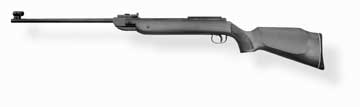
Diana’s model 35 was one of the most powerful spring guns in the 1950s. It was made until 1987.
Manish from Mumbai, India, requested this report, but Graham also wonders about his Winchester 435, which is another variation of the classic Diana 35. I did the first post on the Diana 35 back on December 8, 2005. In that post, I showed you the inside of the pre-unitized Diana trigger group with the ball-bearing sear, and I cautioned you not to take one of these rifles apart unless you’re sure you can get it back together again.
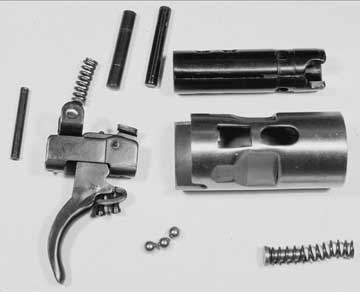
Lots of parts for a simple job. Diana’s ball bearing trigger was a real sales point when the gun was new. It releases about the same as a standard lever-type trigger.
Since that post, I’ve done more research on the Diana 35, along with four other powerful spring guns of the time, and I’ve discovered an interesting bit of information. The other four are the HW 35, Diana 45, BSF 55 and the FWB 124. I wrote a large article about them titled The Four Horsemen for the September 20 Shotgun News. The Diana 35 figured in the research because it was positioned against them as a powerful air rifle of the Diana line, but somehow it never quite measured up.
Back in the 1970s, velocity ruled the day. That’s no surprise, is it? The magic number was 800 f.p.s., and for a while, only the FWB 124 was capable of shooting that fast, in .177 caliber of course. The other powerful rifles all reported velocities in the 700 f.p.s. range, with as little as 10 f.p.s. making a huge difference in sales. If left to their own devices, the manufacturers would have soon blasted past 800, but they were held in check, first by Air Rifle Headquarters and then by Beeman Precision Airguns. Both dealers did their own testing and reported the true numbers, regardless of the outcome.
The outcome was a disaster for Diana. The 35, which was their magnum hope, was rated at 725 f.p.s. in .177 with light pellets. ARH testing revealed only 685 f.p.s. The cheaper, lighter Diana model 27 shot 650 f.p.s., so sales of the Diana 35 languished because it wasn’t that much faster.
Enter The Airgun Revue
Like many airgunners who had lived through the 1970s, I knew what the hot guns had been and had already owned many of them. For some reason, the Diana 35 had eluded me. Then at a Roanoke airgun show in the late 1990s I happened to score a 35 for myself, and resolved to set the record straight in the fifth edition of Airgun Revue. After all, I was tuning spring guns for a living (through my newsletter, that is). Certainly, I could employ “space-age” lubricants (to use Robert Law’s term) to improve on what had been possible 20 years earlier. My .22-caliber rifle was made in November 1977 and was marked as a Hy Score model 809, one of many names by which the Diana 35 went.
The tune
To see how far I could take a 35 I tested mine as it was, which was factory-original. Then, I stripped the action and cleaned it. The inside of the gun was dry and caked with hard lubricant, plus the piston was somewhat rusty. Never a good thing. The cocking effort had been 24 lbs. before the tune. By cleaning and lubricating all the moving parts, that dropped down to 19 lbs. afterward. The gun also buzzed pretty bad before the tune. I used a thin coating of black tar on the mainspring, and I burnished moly grease into the compression chamber and the leather piston seal.
High hopes – dashed
After the tune, my rifle had almost exactly the same power as before (a couple f.p.s. less, to be honest). The cocking effort had dropped and the spring twang was reduced, but the power remained around 11 foot-pounds with RWS Meisterkugeln pellets. In .22 caliber, that works out to about 590 f.p.s. With Crosman Premiers, the gun averaged 542 f.p.s., which produces only 9.33 foot-pounds. At the time, I remember being disappointed that no more power had been found, but my recent research reveals why.
Hamstrung from the start
The Diana 35 had a short-stroke piston that limited the available power. When the design was new in 1953, the 11 foot-pounds it generated in .22 caliber was considered stupendous, but by 1977 it had become mediocre. Rifles like the BSF 55 and the Diana 45 had longer-stroke pistons that were capable of much higher velocities, and the long-stroke FWB 124 that started it all, of course, was one of the most potentially powerful spring guns of the era. Unfortunately for Diana, nothing could be done to remedy the situation, so in the late 1980s, it faded away – replaced by the models 34, 36 and 38 that came out in 1984. These long-stroke spring guns represented modern technology at its best, taking velocity in .177 caliber up to 1,000 f.p.s., where guns like the 35 could no longer compete.
Twenty years have passed since the Diana 35 left the world stage, and the airgun world is now in a renaissance period. Lower-powered spring guns are once again embraced. The Diana 35 is a larger, more adult version of the extremely popular Diana model 27, and many now find it to be an appealing spring rifle to add to their collections. If the spring twang is eliminated and the trigger is tuned to break crisply, the 35 becomes a classic airgun – the kind everyone wishes they still made. If you can ignore the chronograph, the Diana 35 can be a wonderful companion. Viewed that way, instead of as the powerful spring gun it tried to be, you can be very content with this fine old classic.


Morning B.B. I’ve been shooting and enjoying my Made in West Germany Diania 35, since I bought it new maybe 3 decades ago. A perfect back yard shooter.
B.B.
I have a new leapers 8-32×56 scope. What magnification are the mil-dots set up to be accurate at? Is it the full 32x?
Bruce,
Good for you.
B.B.
Mil dot,
Usually the full magnification is the one selected for ranging. I will ask Leapers.
Do you use the WORM formula, or do you pick a standard and size it for ranging?
B.B.
Thanks again for an interesting review.
I have been looking for a while for reviews of the Walther Lever action (or other Levers), perhaps you could look into that in the future?
What exactly is the worm formula? I’m thinking I use that one, I’ve just never heard it called that before. Is that the size of the target in yards times 1000 devided by the size in mils? That’s the one I use. (actually, I use a varient where the top part is size in inches times 27.778)
Speaking of leapers scopes. People say they are cheap. There was a 50 cal at a local store that had won some competition. It had a leapers scope on it. I thought that was interesting. That obviously proves just because they are cheaper doesn’t mean they are bad.
Do you know if the plastic bushing around the threaded part of the cocking knob is split or removed on an Airforce rifle will affect or decrease accuracy?
Hi BB,
At the airgun show in Little Rock you stated that you thought that JSB Exacts were the best pellet for a .22 TSS. When I look for JSB exacts I find several flavors. But from an early blog you seem to be pointing at the 15.8 grain JSB Diabolo Exact Jumbo. Is this correct? Thanks,
Mike T.
B.B.
So was the big secret to breaking 1000 fps just a longer piston? That seems obvious, but maybe only in retrospect.
anonymous, that’s very encouraging to hear about the Leaper’s scope on the 50 cal. You have to assume that is for long-range shooting. I continue to be mystified at the fantastic prices for centerfire rifle scopes. My $100 Leapers scope produces images as clear as I can see. After putting the crosshairs on this image, I don’t know what else a scope can do. I suppose the brightness can always be improved, but it seems like a case of diminishing returns. I guess the only way I can compare for sure is to pay for a $500 scope which I am not willing to do.
Matt61
Andrew (looking for Walther lever-action reviews) – did you see this?
https://www.reviewcentre.com/reviews4019.html
matt61,
It was cool to see that gun with the same scope on it I use. I actually had to get the guy behind the counter to make sure I wasn’t seeing things.
I use a leapers 8-32 on my condor and on my remington xr-100 in .223. I can shoot .2″ groups all day at 100 yards with my .223 (with the right bullet of course, and off a bench) I don’t know how much it could improve if I had a 2000 dollar scope on it. The condor is the same, it hits what I point at. I guess light can be better, expecially at low light conditions. But I just don’t know if the extra light is worth thousands of dollars.
Mil dot,
Leapers says that on all their scopes that adjust greater than 10X, they have standardized the mil dot measurement to 10X, following the military’s lead.
Of course the other magnifications can be used, but a conversion formula must be applied to get the power to 10X.
B.B.
Hi BB,
What is a cantilevered hold?.
You’ve said you do not shoot pistols/handguns two handed and that includes the 1911 .45 ACP am I right from what I’ve heard?.
Hank
Mil dot,
Here is an explanation of the WORM formula:
http://www.globalsecurity.org/military/library/policy/army/fm/23-11/Ch5.htm
B.B.
Andrew,
Lever action airguns:
/blog/2008/2/erma-elg-10-spring-rifle/
To my utter disbelief I have never reported on the Walther Lever Action rifle.
Next week.
B.B.
AirForce plastic bushing,
That bushing should have nothing to do with accuracy.
B.B.
Mike,
I’m not sure what a .22 TSS is, but when I recommended JBSs I invariably mean the 15.8-grain Exact domed pellets. If I mean otherwise, I will be explicit.
B.B.
Hi BB,
TSS = Talon SS. I thought that was a common abreviation.
Mike T
Hank,
A cantilevered hold is when your skeleton assists you in holding a handgun at arm’s length. To read about how to do it, read all parts of this report:
/blog/2008/5/10-meter-pistol-shooting-part-3/
B.B.
Thanks a ton for the review B.B.
Where can I find the serial number for the gun on the cylinder and barrel ? If indeed there is one.
Which Leapers Scope rail would you suggest for the 35 ?
Manish
Manish,
The serial number can be on the underside of the barrel, or on the right or left side of the base block that the barrel is pushed into. It can also be on the spring tube but under the stock.
I’m not sure all Dianas had serial numbers.
A scope mount is a real problem, because the scope base on these rifles is extremely narrow. A 3/8″ mount may fit, but I have no way of checking.
B.B.
BB,
I’m guessing the 35 bore was roughly 1″ and the stroke was well short of 3″. Is that close? It reminds me of my forum research leading up to the QB36-2: many references to the QB36/-1, which was touted at 900fps but fell well short of that in reality. It seems they basically doubled the stroke (to 4″) to actually get to 900fps on the -2. Seems like the mistake is fairly common: people want to increase the power of their gun and shove a “bigger” spring in it, only to find out that it does little if anything.
anonymous,
Thanks for the extra details about the Leapers scope–more grist for the mill. What you are doing with the Remington xr-100 is closer to what I hope to achieve with my Savage police rifle. I’ve heard about this Remington rifle of yours. Most people talk about the M700 but this one has turned in some amazing performances.
Matt61
BG_Farmer,
Yes, the bore was large and the stroke was short. Well under three inches, I’d guess.
B.B.
hi! i’ve got a diana 35 at my house
but yesterday i wasnt at home and my brother and his friend took it
they forgot about the gun, went inside and it was in the rain for almost an hour
and now it wont shoot anymore
can someone help me out? what should i do best?
The rain won’t hurt a spring gun, unless you don’t dry it.
What is wrong. What you you mean, then gun won’t shoot. Are you able to cock it and the trigger won’t release the sear?
What exactly is wrong?
B/.B.
Hi, I have a diana 35 that was my Uncle’s. He bought it in England in the mid 50’s. Does anyone know its value and where I could sell it. I have tried to find out locally and was unable to find out anything. Please email me at swren52@aol.com if you know. Thank you
Sharon
Sharon,
If you have a German Diana 35, it is worth $75 up to $250, depending on the sub-model and condition. If it has a diopter rear sight it is worth the most.
Look here for free classified airgun ads:
http://www.airguninfo.com
B.B.
hi all! can some help me, i need to know where the spring in the bottem right of the picture above goes in the trigger ? i know were the rest of the parts goes i have a original mod 35 made in germany if u have help or a manual email me or put a link up thanks. djprosser@hotmail.co.uk
If you lived in the U.S. I’d send you to this man:
But he buys from places in the UK like John Knibbs. The parts are in the UK.
Get on this forum and ask your question:
http://www.network54.com/Forum/405945/
B.B.
Anonymous with the diana 35 original with ball bearing trigger reassembly problem,
Here’s the link to a post about a diana 27 (same ball bearing trigger as your original 35) complete with diagram and good insight from numerous people. This is the place B.B. encouraged you to visit. Read the whole thing since there are links to other archived articles that might also help you. Here it is:
http://www.network54.com/Forum/405945/thread/1222892661/Diana+27+Re-assembly
Good luck.
kevin
thanks kev!! your link told me what i needed to know. just finished puting it all back together, got new piston seals, new spring,barrel seal, all from http://www.gunspares.co.uk to put it back together had to buy a pipe clam & a C clamp. thanks all
dj pross.
DJ,
Great news! You’re fortunate to have such a resource like gunspares so close to you.
Please consider visiting the current/active comments section where airgunners like yourself are exchanging air gun rebuilding stories, best pellet in certain airguns and generally answering and asking airgun related questions. Here’s the link:
/blog//
Hope to see you there!
kevin
B.B.
Here is some info after I fitted an original Diana 35 spring to my Diana 35 and an original leather washer. It was very frustrating to put the gun back together but I pulled it off.
The surprise was the fps I got after putting it together. I applied moly grease to mainspring, its ends and the main spring. I applied silicon oil 100 grade (viscosity) to the piston seal.
The figures are
898 First shot, lots of dieseling
948 second shot, some dieseling
784 fifth shot, negligible dieseling
815 eighth shot, almost no dieseling
808 ninth shot, ditto
So the Diana is capable of 800fps, or will the numbers go down as I use ? I still have to fit the new o-ring breech seal.
Manish
India
Manish,
Assuming .177 caliber, I would think the rifle would stabilize around 700 or just under. Try again after 100 shots.
B.B.
Hi B.B
I am new one on this blog and don't know much more about guns but i have a Diana Model 35 which i purchased Last year with 300 .22 pellets. Its original Made in Germany. Can you tell me the hunting range of this gun. I am using flat head pellets for hunting. Some time it hits exact on target but some time it miss the target completely. Pleas suggest me what type of pellets i have to use for birds hunting in fields or in open area. I will be tahnkfull to you for help.
Regards,
Aamir
Aamir,
It may not be the pellet's fault. It may be the way you are holding the rifle. It might be a good idea for you to read about the "artillery hold," which often helps increase accuracy significantly for spring rifles. Click on this link to read about it.
Also, you might want to join us on the current day's blog entry by clicking here. There, many other airgunners will see your comments & offer other suggestions.
Edith
Dear Edith,
Thanks for your reply. Please tell me the hunting range of Diana 35 model with .22 pellete.
regards,
Aamir
Aamir,
As Edith suggested you'l get more people answering your question if you post it to the current blog at
/blog// .
I have a Diana 35 in .22 and the range for squirels or similar type animals is limited more by how far I can shoot and hit a quarter sized target under field condictions than the actual distance.
You should check out the link Edith gave you and learn the artillary hold. I expect to get dime sized 5 shot groups from a rest using Crosman Premire pellets all day long.
Shoot well,
Mr B.
Hello
Recently i've been gifted of an old 35, that had been forgotten in an humid underground i think for 20 years or more.
The gun is reduced to a piece of rust, and furthermore its spring had been left loaded… i think it has weakened by alot…
Anyways i'm willing to restore it, i took it apart and have put every metallic part in the oil, just to clean the rust off it.
The first question is: does teh gun have a coat of paint or it is treated naked metal? i thought of heating it and put it in the oil…
the second question is… what can i use as a washer? it is better to keep its leather one or go for a new synthetic washer?
And the last question is… waht mainspring can i use, i mean the powerfullest spring i can use on that gun, and where can i get it?
Thanks 🙂
Aldo
Aldo,
Let's talk about the metal first. It was blued originally. Diana guns were never painted, except for a couple older pistols that were cheap.
You best bet for restoration of the color is Blue Wonder cold blue. Read this report:
/blog/2009/11/diy-shooting-rest-and-a-blue-wonder-followup-report-part-3/
Now let's talk about mainsprings. You cannot increase the power of most spring guns by installing a stronger mainspring. The power is determined by the swept volume of the piston.
The Diana 35 is very much a gun of fixed power because it has a short stroke piston. Therefore, your best bet is to replace the mainspring with an original and lubricate the parts with black tar to make them as vibrationless as possible. Black tar is a slang term for a thick viscous grease that airgunners use to reduce vibration.
Third, I did an extensive report on making new leather breech seals and how to test them. Read this report:
/blog/2009/5/diana-27-part-10/
This is a 10-part report on a tuning job I did on a Diana model 27 that had similar issues to your 35. The 27 was the next-smaller powerplant than the 35 about 30 nyears ago.
B.B.
please discuss about the velocity?
I think it is about 1000ft/s
bu the it is mentioned here it is 700ft/s
Anonymous,
As B.B. shows, the actual velocity never reached the advertised velocity, which was only 800 fps. As far as I know, the Diana 35 was never advertised as a 1,000 fps capable airgun. Are you thinking of a different model, perhaps?
Bobby
Hi everyone,
After 25 years I took my Gecado Model 35 (made in Germany) out of the cupboard only to find that rust had already started. It is a lovely gun and I would like to take it apart, clean and oil it, but don’t really know how to do it.
Is there any diagram, or manual to show how to do it?
Kindly advise.
Hi Milan,
you have left your comment on a blog that is almost two years old. Very few of us monitor these old blogs other than a small core of volunteers, of which I am one.
First, there have been a number of blogs written (they come out Monday to Friday) on tuning an airgun. You can find these articles by using the search box just to the right of the blog. For instance, here's a 4 part series:
/blog/2006/7/spring-gun-tuning-part-4-lets-disassemble-a-gun/
This is part 4. I gave this to you because the URL's for the first three parts are listed and you can start there. The Gecado name was used by G.C. Dornheim of Suhl, Germany until 1940 but was also used in certain German and other markets but the rifle is a product of Dianawerk. Therfore, the rifle will probably disassemble in a similar fashion to the one this article is about. However, I can't be 100% sure but if you re-post to the current blog, you will get much greater exposure and perhaps one of the bloggers will be familiar with this particular model.
You can always find the current blog at:
/blog//
Many on the Blog swear by Ballistol and triple o steel wool to remove rust.
Fred PRoNJ
Many thanks Fred,
I am not that skill on computer, but hope to get it right.
I bought Gecado in early seventees, but as I mentioned before, it wasn't used for the last 25 years.
Fred, I may not get Ballistol here (South Africa), can you tell me what shall I look for<
Thank you
Milan
Milan,
I'm not sure what products would be carried in South Africa. I suggest go to a good hardware store or a sporting goods store that sells firearms and ask the clerk for a good metal protectant oil. For the easy way, regular 30 weight motor oil will do just fine along with very fine steel wool or emory cloth (also called crocus cloth of around 400 or better, grit).
Fred PRoNJ
please any body know if diana 35 is stronger than model 28 & 26? in a manuel I find that model 28 & 26 have the velocity of 235 m/s about 820ft/s but it is mentioned here diana 35 is about 700 ft/s!!!
What is the problem?? diana 35 is the same price as model 34 & 36!!
Bobby Nation mentioned here it is not even 800ft/s??
I am talking about caliber .177
Anonymous,
the published velocity of any air rifle will vary with the weight of the pellet used. As the manufacturer normally does not specify what pellet was used when they measured the rifle's velocity, you can't base your rifle's performance on that. Typically, manufacturers use the lightest pellet they can find to measure a rifles' highest obtainable velocity. Accuracy is not an issue for these tests.
What I suggest is to find others that have a Diana Model 35 and see if they know what velocity their rifles are obtaining and with what pellet. Then compare your rifle's performance. At least you'll find out if your rifle is healthy or not.
The design of a rifle and how fast it shoots is a combination of the transfer port, spring strength and swept area of the piston the spring is pushing. Price of manufacture between a weaker and a stronger spring is insignificant as is the size and shape of the transfer port. You can't judge performance of rifles by price.
Hope this helps.
Fred PRoNJ
Thank you Fred,
Milan
I sent an email to diana company recently and they replied that the only difference is in stock (35 & 36)
I do not know if the velocities are the same?!
In email they siad that we sell this model for arabian markets and we produce the in Germany In these Days! So maybe new Diana 35 are capable of 1000 ft/s
(still I am not sure!)
Anonymous,
don't get too concerned about how fast the rifle will shoot the pellet. With the design of the pellets, if they go too fast, they lose accuracy. You want a rifle that can shoot a pellet in the 8 to 900 fps range. As you hit 1,000 and faster, you run into the sound barrier and the shockwave the pellet creates trying to break the barrier sets up a wobble which the pellet doesn't recover from. Ignore manufacturer's claims on speed and concentrate on accuracy and reliablity.
One last thing, you are posting on a Blog that is two years old. Not many of us monitor these old blogs other than a core of volunteers, of which I am one. For greater exposure to questions and comments, you are best posting on the most current blog. That can be found here.
Off-topic questions are always welcomed. I hope I've given you some advice that you will consider and look forward to seeing you on the curent blog!
Fred PRoNJ
Thanks!
But I am sure 34 , 35 and 36 are the same
History- mine was bought by father in 1985, but later he gave it to my uncle who is a cop and then he returned it to me when i was 18 on 2002.
Now i wish to use it for some pest control, but was disappointed and opened the entire gun including the tube for tuning and found out that the spring provides lesser OOMPH as you use it. I am looking forward for some metal work on that spring on Diana 35 22cal or completely replace it with one single yet strong and long one. Got any suggestions on that, thanks in advance for your advice and your blogs were so helpful.
Ajith,
The spring on a Diana 35 isn't the problem. The swept volumn of the piston is too small to provide much power. A new spring will restore the gun to its original power, but it was never that powerful.
Pyramyd AIR might have the spring you need.
B.B.
Hi, the serial number of my Diana 35 is 347797, is possible to trace the year it was made? belonged to my grandfather. Another thing, below de mark and model, a can read a letter "S", do you know what that means?
Thanks, Ana
Hi, the serial number of my Diana 35 is 347797, is possible to trace the year it was made? belonged to my grandfather. Another thing, below de mark and model, a can read a letter "S", do you know what that means? and last, which would be the current price?
Thanks, Ana
Ana Maria,
Your Diana 35, serial no. 347797 was made between 1969-1970 give or take 6 months.
The "S" designates that you own a Diana 35S model. The Dianawerk Model 35 that you own was manufactured from 1965-1987 and were available in 4 models. The 35, 35M, 35S and 35 Centennial. The Model 35S has a two piece cocking lever, trigger block safety and angular stock style. The 35M was a target stocked version, the 35 Centennial was a commemorative model and the 35 was the plain version.
kevin
I have a diana35 and i was wondering if i can still be able to source parts for it such as springs and pellets,and as to where can i locate them???????
Pellets are widely available. They are not considered to be parts, but rather ammunition. This website we are on, Pyramyd AIR, is the largest airgun dealer in the world. Why not begin here:
https://www.pyramydair.com
Parts for the 35 are also available. Pyramyd AIR sells tham as well as other places. What do you need?
Springs are made and sold by aftermarket dealers, so you don't have to get an exact replacement for a Diana 35 mainspring. But Pyramyd AIR does have them.
B.B.
Hey, my grandfather gave me his Diana 35 cal 5.5/.22 serial 117124.
I wanted to know how hard does it hit, I mean like, is it enough to kill me or can I only shoot cans on my back yard?
I have never shot it and I have to get it repaired, for what I´ve been told, the direction is wrong and it must be rusty on the inside. besides, I don´t have a telescopic sight.
I hope to have a great rifle soon… do you have any suggestions?
P.S: I´m 15
Dantony,
To understand the answers to the questions you have asked, you need to understand some science. First, you asked whether or not your air rifle could kill you. The answer is yes, it can. But only if you are extremely unlucky.
Your air rifle probably generates about 12 foot-pounds. Look up what a foot-pound is on the internet.
For a reliable killing shot on a human it usually takes about 40 foot-pounds of energy or more, but in certain areas of the anatomy, 12 foot-pounds is enough.
I'm giving you an answer that you will not be able to read about on the internet, or to see on television. I'm giving you the entire answer, rather than a quick answer that somebody might give offhand. So I expect you to read and consider the answer I am giving you.
You shouldn't ever ask a question like that. Instead, you should respect the airgun the same as if it were a firearm, because all things that shoot deserve respect. And when you respect an airgun, the kill question never comes up, because you will never allow yourself to be put in that position. Do you understand what I am saying?
Your air rifle is capable of placing five shots inside a dime at 25 yards, if you do your part. However, doing your part means learning how to shoot. Are you willing to devote the time for that, or do you just want to have some fun right now?
You make no sense whatsoever when you say "…the direction is wrong, and it must be rusty on the inside." What in the world are you trying to say?
As far as needing a telescopic sight, I can put ten shots inside two inches at 100 yards with a 125-year-old single shot rifle that doesn't have a scope. You don't need a scope. What you do need is to learn how to shoot.
Would you agree?
Finally, your rifle is very repairable, but it is dangerous for a person who doesn't know what he is doing to fool around with it. You can get seriously injured that way. I understand that you probably do not have a lot of money for this job, but are you willing to spend what it costs to do it right? What if that was as much as $100?
Let me know what you think.
B.B.
Dantony, thanks for being honest about your age. That's important information to know.
When you say you "don´t have a telescopic sight", do you mean that you NEED one because the open sights are missing?
One more thing… I may be able to help with getting it fixed. If you want you can email me at vfblovesnancy@yahoo.com
Hi,
I am trying to restore a Diana 35 (old model). I took the gun apart, I have been able to assemble it back except for the trigger spring and the housing spring. Now the gun does not FIRE.These parts should fit in to the Spring guide or the trigger housing. I tried fitting these in to Spring guide since it has a slot for this, but the spring bends from the middle and does not fit in. Can anyone please help? many thanks in advance.
Nomi,
I can't tell from your description what is happening.
Can you look at the parts at the top of this page and tell me what is not working with them?
B.B.
This comment has been removed by the author.
Thanks BB,
I do not know where the spring with the small screw in bottom right of the picture (above) will be placed? I believe it has to be in the spring guide, not sure though. Please see this schematic and help out http://www.gunspares.co.uk/shopdisplayproducts.asp?id=24381&cat=35
, many thanks.
Nomi
Nomi,
The spring with the rod (it's not a screw) is what returns the trigger mechanism to the uncocked state when the gun fires. It acts on the black metal cylinder that fits inside the silver tube. It is what pushes the three ball bearings back down their respective ramps after the piston has been released.
The piston pushes them up their ramps and to the place where they stop and lock the piston in position.
The screw and rod are the equivalents of a sear return spring.
B.B.
Thanks BB,
will try to do it. I found a pic on another forum, that explains it. http://www.network54.com/Forum/405945/message/1192902537/IIRC
Actually the spring with the rod in it gets bent as is shown in this pic. I tried doing it this way previously as well, but the spring bends from the middle as is shown in this pic and falls down. Will try again many thanks.
Nomi